Lucky7even Payment Methods in Australia: AUD Deposits, Cards, E-Wallets and Crypto
 Available in AU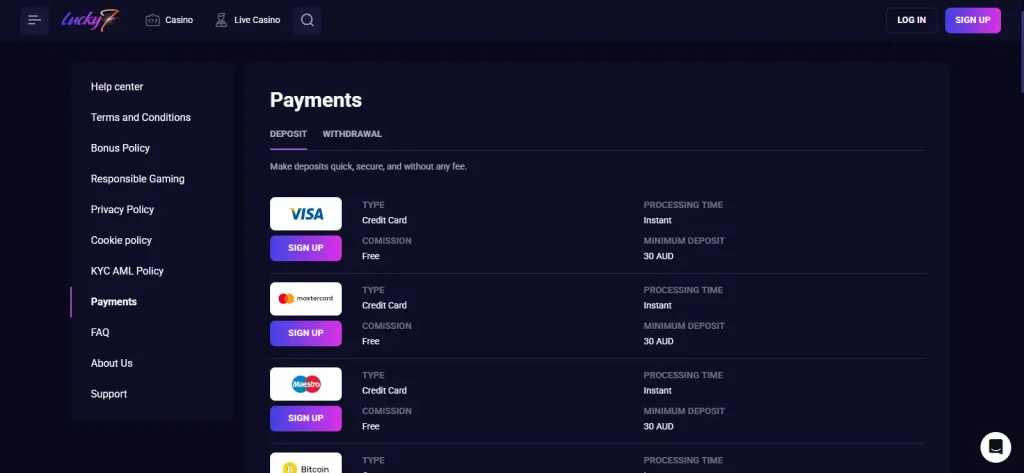
Table of Contents
- AUD support, public payment listings and live cashier availability are different things
- Cards, e-wallets, transfer services and crypto
- Method, fee and processing fields are reference data, not a cashout promise
- Why 30 AUD and 20 EUR equivalents can appear on the same AU page
- Three common ways an Australian reader might compare methods
- Why the AU payment table still needs account-level context
- How local payment habits shape expectations
- Match the payment method to the reason for depositing
- Withdrawals and verification need their own checks
- Payment availability and Australian regulatory context are separate checks
- Current AU payment facts and method availability
- How Lucky7even payments fit Australian payment habits
Section element
Australia payment guide
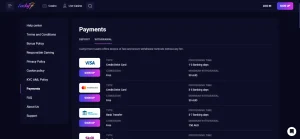
Lucky7even supports AUD and its English-AU payments page publicly displays card, e-wallet, banking or transfer, voucher-style and crypto methods. Examples visible on that page include Visa and Mastercard, Skrill and Neteller, several other e-wallets, banking or transfer services and major cryptocurrencies. That public catalogue should not be read as a guarantee that every listed rail appears in every Australian account. Lucky7even’s own FAQ says withdrawal options include methods available in the player’s region, so the public list is better read as a catalogue than as a promise for every cashier. The public table also mixes local and generic currency logic: many fiat rows show a 30 AUD minimum, while crypto rows use equivalents tied to 20 EUR. The useful distinction is therefore between AUD support, methods shown on the public AU page and methods confirmed for a specific account at the point of deposit.
Three-layer payment check
AUD support, public payment listings and live cashier availability are different things
Those three layers answer different questions and should be kept separate. AUD support establishes the account currency, the public payments page shows method categories, and the live cashier determines which options are actually presented to a particular account.
1. Supported currency
AUD is a supported Lucky7even account and payment currency. That means Australian-dollar balances and AUD-denominated figures can appear on the AU site.
2. Public AU payment page
The public page displays cards, e-wallets, banking or transfer services, vouchers and cryptocurrencies. It is useful evidence of the payment catalogue Lucky7even presents on its AU surface.
3. Account cashier
The FAQ makes payment and withdrawal options region-dependent. The FAQ’s regional wording means the public methods are displayed options, not a promise that every one will appear for every player.
What the AU page displays
Cards, e-wallets, transfer services and crypto
The current public table is broad enough to cover several different payment habits. The examples below are methods visibly listed on the AU page, grouped by category rather than treated as guaranteed cashier availability.
| Category | Examples displayed publicly | What the page shows | What it does not prove |
|---|---|---|---|
| Cards | Visa, Mastercard, Maestro | Card deposit rows are shown with AUD minimums on the AU page. | That a particular issuer or card will be accepted for every account. |
| E-wallets | Skrill, Neteller, Ecopayz, MiFinity, MuchBetter, AstroPay | Multiple wallet brands appear in the public catalogue. | That every wallet is available to every Australian user at checkout. |
| Banking and transfer | iDebit, Interac and other transfer-style entries | Banking or transfer options appear alongside card and wallet methods. | That the public list is a real-time view of a specific account’s region and bank eligibility. |
| Crypto | Bitcoin, Ethereum, Litecoin, Bitcoin Cash, Dogecoin, USDT | Several cryptocurrencies are listed for deposits and withdrawals. | That crypto minimums are natively denominated in AUD or that every coin is always enabled. |
Reading the public table
Method, fee and processing fields are reference data, not a cashout promise
The public AU payment table includes columns for method type, commission, processing time and minimum amount. Those fields are useful for comparing how Lucky7even presents its payment catalogue, but they should be read together with the FAQ’s statement that available withdrawal options depend on region.
The public processing-time column is not a guarantee for an Australian withdrawal. Exact payout timing can depend on the method and the account conditions at the time of cashout; the dedicated withdrawal page covers those rules. For deposits, the immediate question is whether the method is shown in the account cashier with the expected currency and minimum.
Fiat and crypto are presented differently
Why 30 AUD and 20 EUR equivalents can appear on the same AU page
The payment table is localized enough to show 30 AUD minimums for many fiat methods, yet the crypto rows define their minimums by reference to a 20 EUR equivalent. That is useful evidence about how the public table is constructed.
For a card or e-wallet row labelled with a 30 AUD minimum, the Australian-dollar figure is straightforward to read as the public threshold displayed for that method. Crypto is different because the amount of BTC, ETH or another coin can move with exchange rates. The page therefore expresses the crypto threshold as a coin amount equivalent to 20 EUR rather than fixing one AUD number.
This does not require a reader to convert currencies manually. The practical point is simpler: check the live crypto amount shown at the time of deposit and do not assume that the value displayed on an earlier visit remains identical later.
Payment choice by use case
Three common ways an Australian reader might compare methods
Card-first user
A card user can see familiar Visa and Mastercard entries on the public AU page. The next question is not whether cards exist in the catalogue, but whether the user’s own card is enabled in the account and what the cashier shows before the deposit is confirmed.
E-wallet user
The public list includes several wallet brands, which creates more choice than a card-only cashier. Wallet preference can be useful for separating gambling transactions from everyday card spending, but availability still follows the region and account conditions shown by Lucky7even.
Crypto user
Crypto users have multiple coins displayed publicly, but the minimum logic is tied to EUR equivalents rather than a fixed AUD threshold. That makes the transaction screen especially important for confirming the actual coin amount required at the time of payment.
Read the table carefully
Why the AU payment table still needs account-level context
Many fiat deposit rows on the current AU page display a 30 AUD minimum. Crypto rows are different: they use coin amounts defined as equivalents to 20 EUR. That mixed denomination is a sign that the page combines localized and cross-market payment logic rather than presenting a purely Australian cashier specification.
The same public page also prints processing-time and fee fields, but exact withdrawal timing and limits are handled separately in the Lucky7even withdrawal limits guide. A public table can describe a method category without proving the exact cashout experience for a particular account.
Australian payment context
How local payment habits shape expectations
The Reserve Bank of Australia’s 2025 Consumer Payments Survey, published in May 2026, provides useful context for what Australians are accustomed to using. It is market context, not proof that Lucky7even supports a particular rail.
Cards still dominate
RBA survey data show cards accounted for about 73% of consumer payments in 2025, with debit cards alone representing about half of payments. A casino payment page that foregrounds cards therefore matches a very familiar Australian payment behaviour.
Mobile wallets are mainstream
The RBA found that 43% of consumers used a mobile device for a contactless payment during the survey diary week. That helps explain why Australians may expect digital wallet convenience even when a specific merchant’s supported wallet list differs.
PayID is common, but not brand proof
About half of surveyed consumers had used PayID in the previous year. Lucky7even’s current public payment information does not establish PayID support, so local popularity should not be treated as proof that the casino offers it.
For the underlying Australian market data, see the Reserve Bank of Australia consumer payment behaviour report.
Deposit planning
Match the payment method to the reason for depositing
If the deposit is meant to activate a promotion, payment choice is only one part of the decision. The bonus deposit requirements page explains the current welcome structure, wagering and bonus-specific thresholds. A method that appears convenient is not automatically the best fit if a promotion introduces stake or wagering conditions the player does not want.
If the priority is simply funding an account in AUD, focus first on whether the method appears in the live cashier and whether the amount is shown in the currency you expect. The public AU table is a useful reference point, but the account screen is the place where regional availability becomes operational.
Deposits are only half the flow
Withdrawals and verification need their own checks
The method used to deposit does not by itself tell you which withdrawal route, timing or limits will apply later. Lucky7even’s FAQ says withdrawals can use cards, e-wallets or other options available in the user’s region, so cashout should be treated as a separate account-level step.
Identity checks can also affect the path from balance to withdrawal. The registration and KYC guide explains the verification side without assuming that a particular document request applies to every user. For exact cashout rules, use the dedicated withdrawal page rather than the deposit table.
Regulatory context
Payment availability and Australian regulatory context are separate checks
Payment methods and currency support answer transaction questions. The broader rules and regulator history are a separate topic, covered in the Australian regulatory context page.
Current AU payment facts and method availability
Lucky7even’s official English-AU payments page displays AUD and the public payment-method categories, while the AU FAQ states that available methods depend on region. The Reserve Bank of Australia’s May 2026 Research Discussion Paper provides broader Australian payment context; it does not establish that any particular Lucky7even cashier method is available to every account.
Practical fit
How Lucky7even payments fit Australian payment habits
Lucky7even’s AUD support and broad public payment catalogue line up with the card and digital-payment expectations common in Australia. The important boundary is that a public AU table is not the same as a confirmed live cashier for every account, especially when the page mixes AUD fiat minimums with crypto thresholds tied to EUR equivalents. Australian payment habits can help a reader judge convenience, but they should not be used to invent support for PayID or any other unverified rail. The most reliable deposit decision is therefore made after checking the logged-in cashier, then treating bonus, withdrawal and KYC conditions as separate questions. The full review connects those payment questions with the rest of the Australian product and regulatory context.